I gave this talk at ScalaDays 2026 in Berlin. This post is the written version, with the code and the data.
TL;DR
We take the textbook interpreter of a small lambda calculus and, with Scala 3 staging, turn it into a compiler that emits JVM code at runtime. The core of the idea is a few dozen lines. The production version in Scalus runs real Cardano smart contracts about three times faster than the Haskell reference VM. And the hardest part was neither speed nor semantics: it was a quadratic compile time hidden behind a $, and the fix is one rule – create each Expr where it will live.
All the code from the talk is on GitHub at the tag scala-days-2026. The slides are here.
Act 1: the quest
A smart contract is a pure function
Quick context, if you have never touched a blockchain. On Cardano a smart contract is a validator: a pure function of the transaction that either returns or fails. If it fails, the transaction is rejected.
// illustrative: the shape of a validator
def validator(datum: Data, redeemer: Data, ctx: ScriptContext): Unit
// returns → the transaction is valid · fails → it is rejected
Every node re-executes every validator, and that puts four demands on the language it runs in:
- Deterministic. The same answer on every node, on every OS, forever.
- Metered. Every step costs CPU and memory budget, paid in fees – otherwise anyone could submit an infinite loop.
- Correct. Bugs lock real money, so we want a language we can reason about formally.
- Hot. Off the main chain, the same scripts run over and over: in layer-2 protocols, in emulators and indexers, and in tests. Property-based testing of a contract means running one script thousands of times.
The last word is why this post exists. The same code, again and again, is exactly the workload where a JIT shines.
Why lambda calculus
Cardano's answer is Plutus Core: untyped lambda calculus, designed at IOG by a team that included Phil Wadler.

Phil Wadler (right) and me at the IOHK Summit 2019. Photo: Alexander Nemish.
Phil is one of the designers of Haskell and the author of Propositions as Types: a type is a proposition and a program is its proof. Lambda calculus is where logic and computation are the same thing, so if you want to prove things about programs, that is where you want to be.
It is also tiny: three constructs and one reduction rule. And it is mechanized, in Agda and in Lean 4. On-chain it is untyped, so the chain does not need to trust a type checker.
The price for all of this: it was not designed to be fast. That is our job.
Real compiler output: fib from Scala
Here is a plain Scala fib, annotated with @Compile (imports left out):
@Compile object FibContract:
  def fib(n: BigInt): BigInt = if n <= 1 then n else fib(n - 1) + fib(n - 2)
The Scalus compiler plugin turns it into this UPLC (names shortened):
[(lam fib [fib fib])
  (lam fib
    (lam n
      (case [(builtin lessThanEqualsInteger) n (con integer 1)]
        [(builtin addInteger)
          [fib fib [(builtin subtractInteger) n (con integer 1)]]
          [fib fib [(builtin subtractInteger) n (con integer 2)]]]
        n)))]
Two things to notice. Recursion: UPLC has no letrec, so the function takes itself as an argument – [fib fib]. The talk opened with the program (lam x [x x]): self-application, which applies its argument to itself. Apply it to itself and it runs forever. Self-application is exactly how recursion compiles. And the conditional: Scala's if becomes case on a builtin Bool. case is lazy: False picks the first branch, True the second, and only the chosen branch is evaluated.
Our goal: the smallest UPLC that runs exactly this program – and make it fast.
The smallest UPLC, as one Scala 3 enum
In Scala 3 the whole language is one enum (Term.scala, trimmed):
enum Term:
  case Var(name: String)
  case LamAbs(name: String, body: Term)
  case Apply(fun: Term, arg: Term)
  case Constant(value: Const)
  case Builtin(fn: DefaultFun)
  case Case(scrutinee: Term, branches: List[Term])
  case Error

enum Const:
  case Integer(value: BigInt)
  case Bool(value: Boolean)
Exactly the constructs fib needs, plus five integer builtins: add, subtract, multiply, equals and less-than-or-equals. Four rules to remember:
- Application is strict: arguments are evaluated before the call.
caseon aBoolis lazy: only the chosen branch runs.Erroris the only way to fail, so a validator either returns or errors.- Integers are
BigInt. UPLC integers are arbitrary precision. If we silently overflowed aLong, the same contract would mean different things on different VMs – a consensus bug.
Exact semantics will be a recurring theme. Real Plutus V3 has more – delay and force, constructors, bytestrings, the Data type, about a hundred builtins – but they all follow the same patterns.
The CEK machine, on a napkin
The Plutus Core specification defines evaluation with a CEK machine, from Felleisen and Friedman. Three registers: Control, the term being evaluated; Environment, the values of its free variables; and Kontinuation, what to do with the result – an explicit stack of frames on the heap.
The design goal for Plutus Core was that its semantics fit on a napkin. At PlutusFest 2018, IOHK took that literally and printed the CEK rules in gold on black napkins:
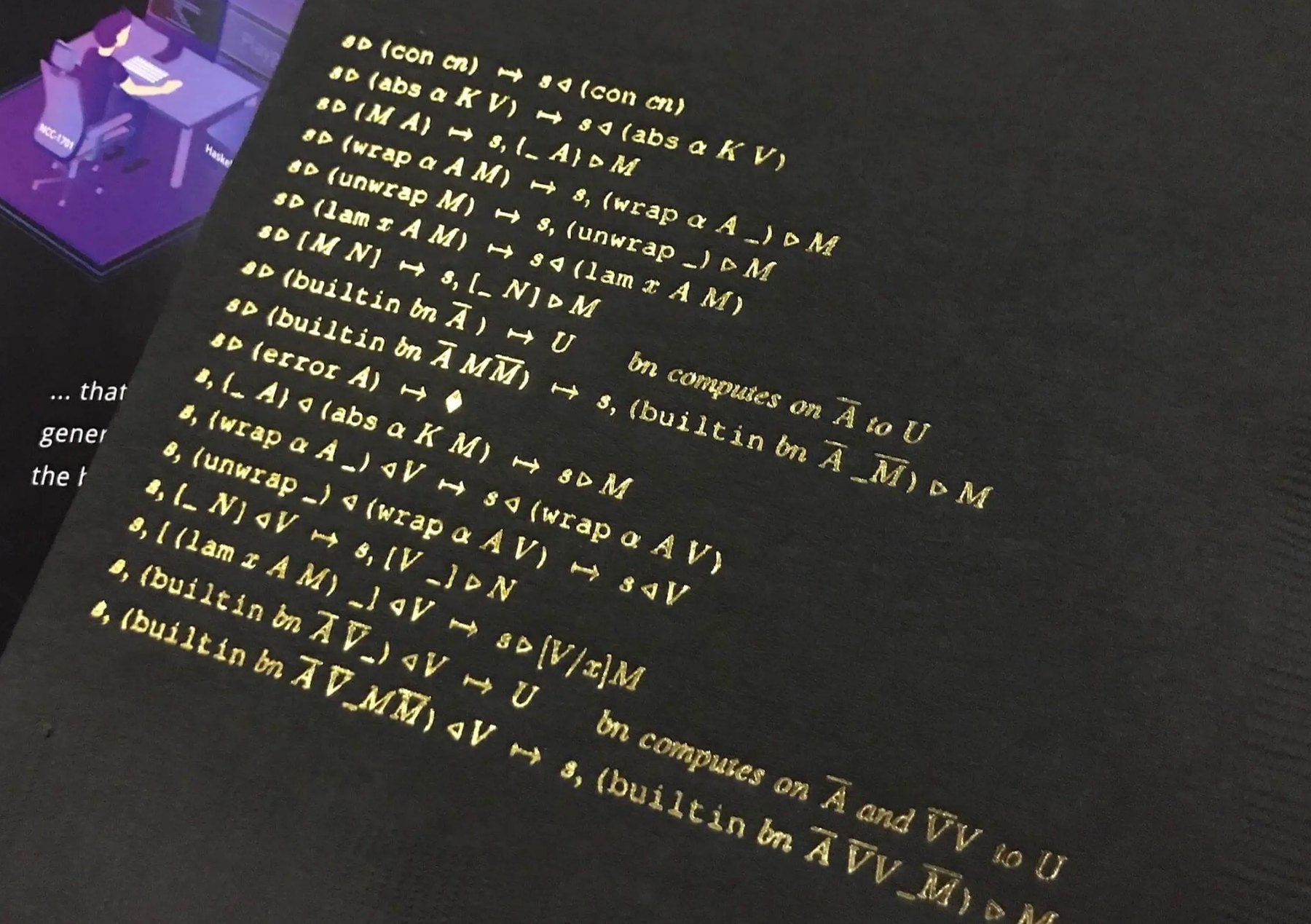
The CEK machine on a napkin, PlutusFest 2018. Photo: Alexander Nemish.
Every line is one transition: s ▷ M means "compute M with stack s", s ◁ V means "return V to stack s". That is the whole machine. Because the continuation lives on the heap, it never overflows the JVM stack, however deep the recursion. Remember that – it comes back to bite us.
Here is the machine in Scala (Cek.scala, trimmed to the transition function):
@tailrec
private def run(state: State, stack: List[Frame]): Value = state match
  // ---- compute: decompose the term ----
  case Compute(Var(x), env)       => run(Return(lookup(env, x)), stack)
  case Compute(LamAbs(x, b), env) => run(Return(VLam(x, b, env)), stack)
  case Compute(Constant(c), _)    => run(Return(VCon(c)), stack)
  case Compute(Builtin(fn), _)    => run(Return(VBuiltin(fn, Nil)), stack)
  case Compute(Apply(f, a), env)  => run(Compute(f, env), ApplyArg(a, env) :: stack)
  case Compute(Case(s, bs), env)  => run(Compute(s, env), CaseFrame(bs, env) :: stack)
  case Compute(Error, _)          => throw EvaluationError("(error) evaluated")

  // ---- return: feed the value to the top frame ----
  case Return(v) =>
    stack match
      case Nil                     => v
      case ApplyArg(arg, env) :: k => run(Compute(arg, env), ApplyTo(v) :: k)
      case ApplyTo(fun) :: k       => run(applyValue(fun, v), k)
      case CaseFrame(bs, env) :: k => run(Compute(bs(branchIndex(v, bs.size)), env), k)
Two kinds of state. Compute looks at the shape of the term: a variable or a lambda returns immediately, and Apply and Case push a frame that says what to do later, then continue with the function or the scrutinee. Return pops a frame and decides: compute the argument, apply the function, or pick exactly one case branch – that is where the laziness of case comes from.
Every case is one rule from the napkin, and @tailrec turns the whole thing into a loop. About eighty lines, obviously correct, never overflows. The problem: every run re-examines every node of the tree, allocates states and frames, and searches the environment by name.
The bet
At the talk I asked the room to bet. Same algorithm – a CEK machine, the interpreter the Plutus specification describes – written twice:
- A. The reference implementation in Haskell,
plutus-core, tuned for years by people who really know GHC. - B. The same machine in Scala, on the JVM, with HotSpot's JIT behind it.
Same 89 real contracts from a public benchmark, same machine. Which one is faster?
Place your bet before you read on. On the run I showed in the talk, Haskell won by 17 %: 220 µs against 256 µs per contract. The same interpreter in a different language is just the same interpreter.
Two weeks later the Scala one wins – 171 µs against 276 µs on our public benchmark – after we rewrote its inner loop and the benchmark moved to a new harness. But the point of the bet stands: an interpreter is still an interpreter. With the same JVM and Scala 3 metaprogramming, we get about three times faster than the Haskell VM. Not a faster language – a different idea.
Act 2: the climb
What if we don't interpret at all?
UPLC is lambda calculus. Scala has lambdas. The JVM is extremely good at running lambdas. What if, instead of interpreting, we translate UPLC lambdas into JVM lambdas and builtins into plain arithmetic – at runtime, when the script is loaded – and let the JVM's JIT compiler do the heavy lifting? We climb there in two steps.
Tier 1: a tree of closures
If the CEK machine is tier zero, like the interpreter in HotSpot, here is the first step up, with no metaprogramming yet. We walk the term once and build a tree of Scala closures; each node becomes a function from the environment to a value (ClosureCompiler.scala, simplified):
type Code = Frame | Null => Any // built once, run many times

private def compileTerm(term: Term, scope: List[String]): Code = term match
  case Var(name) =>
    val depth = scope.indexOf(name) // resolved at compile time
    env => lookup(env, depth)
  case LamAbs(name, body) =>
    val bodyCode = compileTerm(body, name :: scope)
    env => (arg: Any) => bodyCode(Frame(arg, env)) // a real JVM lambda
  case Apply(fun, arg) =>
    val funCode = compileTerm(fun, scope)
    val argCode = compileTerm(arg, scope)
    env =>
      val f = funCode(env) // the function first, then the argument
      Runtime.apply(f, argCode(env))
  // … constants, builtins, case, error
Variable names become depths at compile time. A UPLC lambda becomes a real Scala lambda. Application is just a call, and saturated builtins become direct calls on BigInt. This classic technique already gives 16× over our CEK machine on fib 20.
Why isn't that the end? Because the interpreter is still there, just hidden. Every node is a call to Function1.apply, and at that call site the JVM sees hundreds of different closure classes – a megamorphic call it cannot inline. Variables still live in a runtime linked list. And the structure of the program is data the JVM cannot see. What we really want is for the program itself to become JVM code: generate well-typed Scala at runtime and compile it. That is exactly what Scala 3 staging gives us.
Tier 2: Scala 3 staging in two operators
Scala 3 staging in one example. A quote, '{ e }, is the code of an expression: a value of type Expr[T], not its result. A splice, ${ e }, inserts generated code into a quote.
// x^n, with the loop unrolled at runtime
def power(x: Expr[Double], n: Int)(using Quotes): Expr[Double] =
  if n == 0 then '{ 1.0 }
  else '{ $x * ${ power(x, n - 1) } }

given staging.Compiler = staging.Compiler.make(getClass.getClassLoader)

val cube: Double => Double =
  staging.run('{ (x: Double) => ${ power('x, 3) } })
// compiled: (x: Double) => x * (x * (x * 1.0))
power generates the multiplications for a known n: the loop runs at generation time, the multiplication at run time. staging.run runs the real Scala compiler inside your JVM, loads the bytecode and hands you a function. And crucially, the quotes are type-checked when you compile the generator, so you cannot generate ill-typed Scala. Compare that with string concatenation or ASM bytecode.
This has a name. Yoshihiko Futamura showed in 1971 that specializing an interpreter to one fixed program is the same as compiling it – the first Futamura projection. Scala has a long line of making it practical: Tiark Rompf and Martin Odersky's Lightweight Modular Staging in 2010, and the quotes and splices above, from Nicolas Stucki, Aggelos Biboudis and Martin Odersky's 2018 paper that unified multi-stage programming and macros. The same quotes serve compile-time macros and run-time staging.
So the plan: take the interpreter we already understand, and make it return code instead of values.
Staging: an interpreter that returns code
Here is the core of the staged compiler (StagedJit.scala, simplified):
private def gen(term: Term, env: Map[String, Expr[Any]])(using Quotes): Expr[Any] =
  term match
    case Var(name) => env(name) // a JVM local: no environment at runtime
    case LamAbs(name, body) =>
      '{ (arg: Any) => ${ gen(body, env.updated(name, 'arg)) } }
    case Apply(fun, arg) =>
      '{
        val f = ${ gen(fun, env) }
        Runtime.apply(f, ${ gen(arg, env) })
      }
    case Constant(c) => genConstant(c)
    case Error       => '{ Runtime.fail() }
    // … plus the two idioms below

def compile(term: Term): () => Any = staging.run('{ () => ${ gen(term, Map.empty) } })
Look how close it is to the closure compiler, and to an interpreter. gen walks the term, but instead of returning a value, it returns code. A UPLC variable maps to the Expr of a Scala lambda parameter: at runtime it is a JVM local, captured natively by closures, and the environment disappears. A UPLC lambda becomes a quoted Scala lambda, with its body generated while the parameter is in scope. Hygiene comes for free: every quote creates a fresh symbol, so shadowing just works.
Pattern-match the idioms away
The real wins come from recognising idioms. Two custom extractors (Patterns.scala) find the shapes Scalus emits, and quotes turn each one into the Scala you would write by hand (simplified from StagedJit.scala):
// (case c else then) on a Bool ⇒ a native if: only one branch runs
case IfThenElse(c, t, e) =>
  '{ if ${ genBool(c, env) } then ${ gen(t, env) } else ${ gen(e, env) } }

// [(builtin addInteger) a b] ⇒ BigInt arithmetic, no currying
case SaturatedBuiltin(AddInteger, List(a, b)) =>
  '{
    val x = ${ gen(a, env) }
    val y = ${ gen(b, env) }
    Runtime.asInteger(x) + Runtime.asInteger(y)
  }
Scalus compiles every if/else to case on a Bool with two branches; we turn it back into a native if. When the condition is a comparison, genBool emits a primitive Boolean: no boxing, no type check. Saturated builtin calls become plain BigInt arithmetic instead of curried function calls.
Note the vals, and that each gen call sits inside its splice. Both are on purpose. The vals are about semantics – see "Fast and exactly the same" below. Where the gen calls sit is the twist of this story.
What the staged compiler writes for fib
This is the actual output of StagedJit.showCode for the fib that Scalus compiled, lightly trimmed and renamed:
((fib: Any) => ((n: Any) =>
  if ({ val x = n; val y = BigInt(1L); asInteger(x) <= asInteger(y) })
  then n
  else {
    val x = {
      val f = Runtime.apply(fib, fib) // [fib fib]
      Runtime.apply(f, { val a = n; val b = BigInt(1L); asInteger(a) - asInteger(b) })
    }
    val y = {
      val f = Runtime.apply(fib, fib)
      Runtime.apply(f, { val a = n; val b = BigInt(2L); asInteger(a) - asInteger(b) })
    }
    asInteger(x) + asInteger(y)
  }))
A Scala lambda taking fib, returning a lambda taking n. Scalus' case became a native if with a BigInt comparison. In the else branch, the self-application [fib fib] is a call, then the recursive call with n - 1; the same for n - 2; then an addition. There is no interpreter left. It is the code you would write by hand if you translated UPLC to Scala – except a program wrote it, at runtime, in tens of milliseconds. For a program this small, that is. Hold that thought.
Then the JVM finishes the job
Four stages, and two of the compilers we did not write:
- UPLC term: the deserialized script.
Expr[Any]: our generator builds it from quotes.- Bytecode:
scalac, running inside our process via staging. - Machine code: HotSpot's C2, or Graal, once the code gets hot.
The JVM profiles the hot code and compiles it to machine code. It inlines the small monomorphic lambdas into straight-line code, removes temporary allocations with escape analysis, and turns our runtime type checks into branches that are always predicted correctly. We wrote one tiny compiler and got two industrial-strength ones for free.
The live demo compiles fib from Scala with Scalus, converts the UPLC to our mini-UPLC and races the engines:
$ sbt "scalusBridge/run 20"
| Engine | µs per run | Against the CEK machine |
|---|---|---|
| CEK machine | 6,387 | 1× |
| Closure compiler | 389 | 16.4× |
| Staged compiler | 183 | 35.0× |
fib 20 is about 22,000 recursive calls, so these are milliseconds; real contracts take hundreds of microseconds. Our toy CEK machine is deliberately simple, so 35× overstates the real-world gap. The real-world numbers come in Act 4.
Fast and exactly the same
Making it fast is easy. Making it exactly the same as the reference is the job, because if two nodes disagree on a script, that is a consensus bug.
- Untyped means
Any. Every use checks its type at runtime, and must fail exactly where the CEK machine fails. - Evaluation order. All arguments are evaluated first, then checked. If you type-check the first argument before you evaluate the second, a program whose second argument loops forever behaves differently. That is what the
vals in the builtin code are for. - Lazy
case, strict calls. Only the chosen branch of acaseruns, while every argument of a call runs, even if it is unused. - Budget. Plutus charges for every step. The production JIT in Scalus emits the same cost accounting into the generated code, charges exactly what the CEK machine charges, and passes the Plutus conformance suite.
And one more: compiled code uses the JVM call stack. Non-tail recursion 100,000 deep is fine for the CEK machine, whose stack is on the heap, but both compilers blow up:
── sumTo 100000 ──
CEK machine        (con integer 5000050000)
Closure compiler   StackOverflowError!
Staged compiler    StackOverflowError!
The Scalus JIT counts its call depth, and when recursion gets too deep, it falls back to the CEK machine. The execution budget also caps how deep a valid script can recurse.
The rule behind all of this: keep the boring interpreter as the oracle, and test every engine against it – especially on programs that fail.
Act 3: the twist
Real scripts took minutes to compile
fib compiled in tens of milliseconds. Then we pointed the Scalus JIT at every real contract in the benchmark.
Median compile time: 22 seconds.
Or, as we used to call it back in the Scala 2 days: fast.
The biggest scripts blew through a two-minute timeout, and the time grew faster than the script did. Add the JVM warm-up the generated code needs – about 20 seconds before it reaches full speed – and the honest break-even was a median of 175,000 evaluations before the JIT beat the plain interpreter. Fine for a test suite, pointless for almost anything else. One more trap: a staging compiler that you keep alive keeps growing, so we used a fresh compiler per script.
But 93 % of the time was not scalac. It was in our own generator, before scalac even started. So I decided to fix the compile times. I opened a terminal and said: "Claude, --dangerously-skip-permissions, figure out what's going on."
A few hours later it came back and said: "scalac wasn't slow. You were."
The investigation
Here is what it found.
- Profile. 93 % of the time is in our generator, building the expressions, not in the Scala compiler. My first guess was that unpickling the quotes was expensive. The profiler said: one percent. Over half of the samples were in two places that copy trees to change their owner.
- Shape. On log-log axes, compile time against script size has a slope of about 1.45: the time grows faster than the script. Something does extra work at every level.
- Cause. In Scala 3's quote system, every tree has an owner: the
valor the lambda it was created inside. Our generator built each sub-expression first, as a plain value, and then spliced it into a quote under a newvalor a new lambda. That expression now had the wrong owner, so the compiler fixed it the only safe way: it walked and copied the whole subtree to change the owner. One level up, we did it again, to a tree that contained the first copy.
A node at depth d gets copied d times. Quadratic, and completely invisible in the source, hidden behind a $.
The fix: create an Expr where it will live
The fix is almost embarrassing, and you have already seen it in the builtin code above. Here are the two generators side by side, for one case (StagingCostExperiment.scala, trimmed, comments added):
// Before: quadratic. Children are built first…
case Apply(Apply(Builtin(AddInteger), a), b) =>
  val ea = gen(a, env)
  val eb = gen(b, env)
  '{
    val x = $ea // …then re-owned here: the whole subtree is copied
    val y = $eb
    Runtime.asInteger(x) + Runtime.asInteger(y)
  }
// After: linear. Each child is generated inside the splice where it lives.
case Apply(Apply(Builtin(AddInteger), a), b) =>
'{
val x = ${ gen(a, env) }
val y = ${ gen(b, env) }
Runtime.asInteger(x) + Runtime.asInteger(y)
}Before: build the sub-expressions, then splice them in. After: call the generator inside the splice, so each expression is created directly where it will live, with the right owner from birth. Nothing to copy. For that to work, the generator takes the Quotes of the splice it runs in, not one captured at the top. The generated program is identical – same shape, same speed. Only the order in which we build it changed.
In Scalus there were two copies: our own changeOwner on every lambda body, and the re-owning that staging does for every Expr spliced under a val or a closure. Both went away. The results on all 89 contracts:
| Scalus JIT, 89 contracts | Before | After |
|---|---|---|
| Median compile | 22 s | 2.3 s |
| Slowest compile | 197 s | 7.7 s |
| Our generator, share of compile | 93 % | 6 % |
| Break-even against the CEK, median | 175,000 runs | 16,000 runs |
The steady speed did not change: 3.9× the interpreter. scalac itself took about two seconds, before and after. Staging was never the slow part.
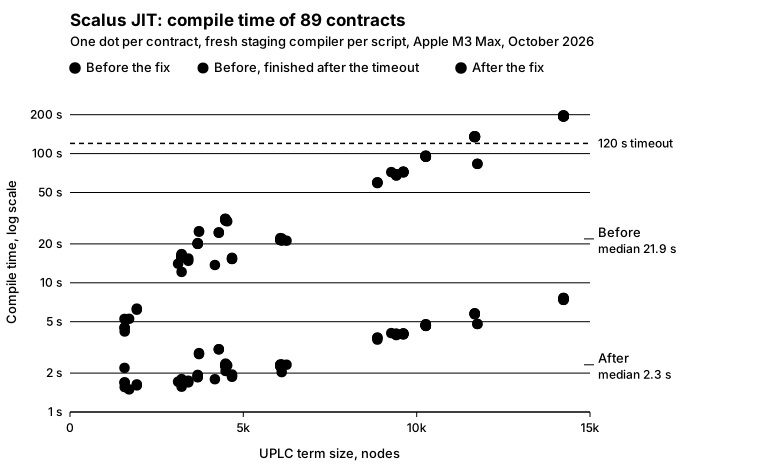
Compile time against script size, one dot per contract, log scale. Data: before, after.
While we were in there, we also found why a long-lived staging compiler keeps growing: every staging run got the same run id, so a compiler cache was never cleared. That one is fixed upstream in scala/scala3#27335.
The rule to take home: create each Expr where it will live.
Act 4: lessons
Real-world numbers
The benchmark is 89 real contracts – auctions, escrows, crowdfunding, a Uniswap clone – run by every VM on one machine. Time per contract, after compilation and warm-up:
| Talk run (Mac, 11 Oct) | Public run (cloud server, 27 Oct, eval only) | |
|---|---|---|
| Scalus JIT | 71 µs | 94 µs |
Haskell plutus-core (the reference) | 220 µs | 276 µs |
| Scalus CEK (our interpreter) | 256 µs | 171 µs |
| Rust | 363 µs | 365 µs |
The machines and the benchmark harness differ, so compare within a column. In both, the JIT is about three times faster than the Haskell VM, and up to nine times on some contracts. On a few contracts – some tiny, some the biggest – the interpreters still win. On the biggest ones, the JVM needs more warm-up than the benchmark gives it, and emitting fewer, larger methods is our next job.
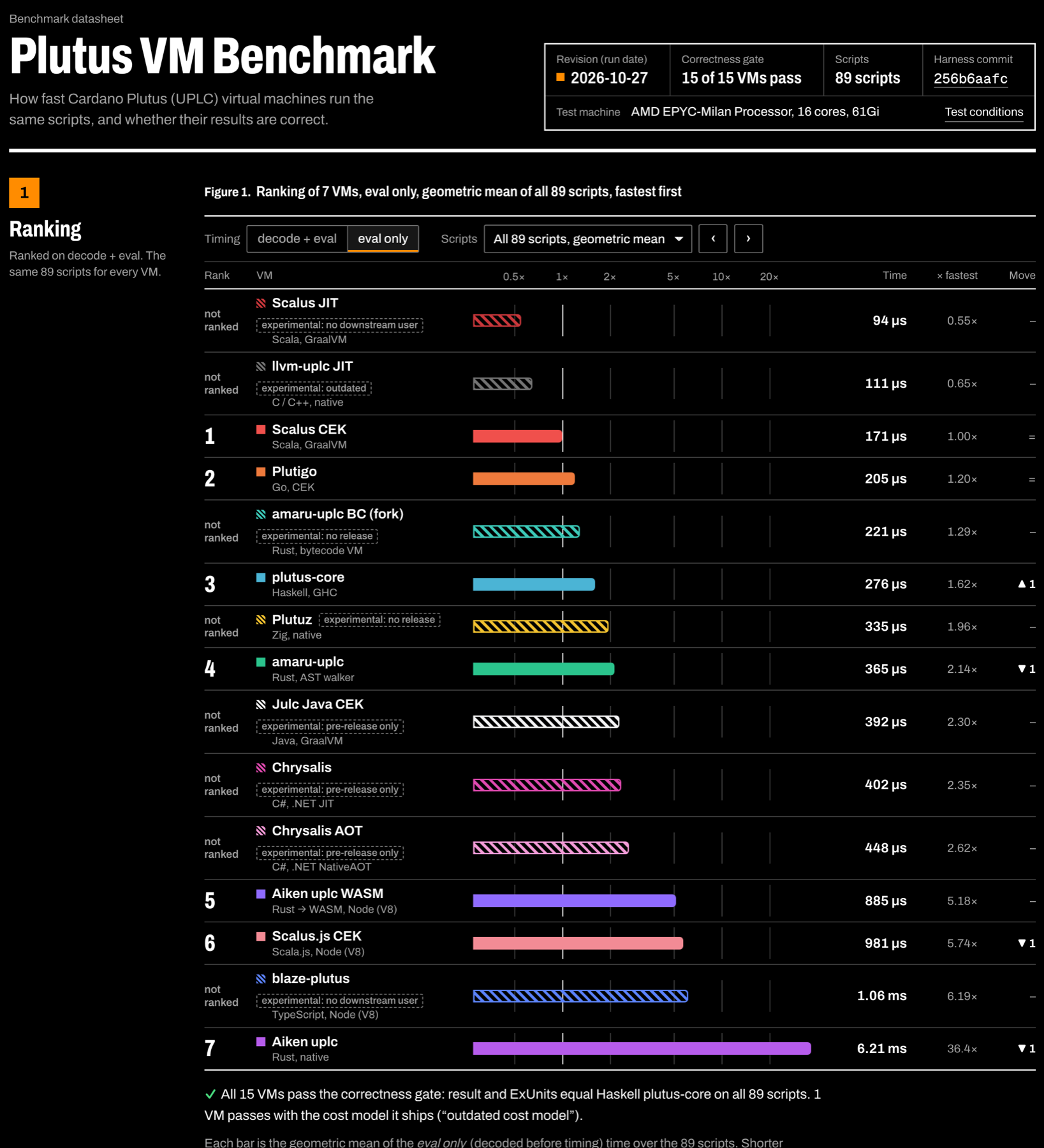
The eval-only ranking on plutus-vm-bench.lantr.io, run of 27 October 2026. The Scalus JIT is shown but not ranked, because it compiles each script before the timed loop.
Where does a JIT pay? A cache for hot scripts
Here are four weeks of Cardano mainnet from early 2025: 311,393 script runs of 2,224 different scripts. Most runs were Plutus V2 scripts, and among them the 10 most used did 60 % of the runs and the top 100 – 6 % of the scripts – did 93 % (how we counted).
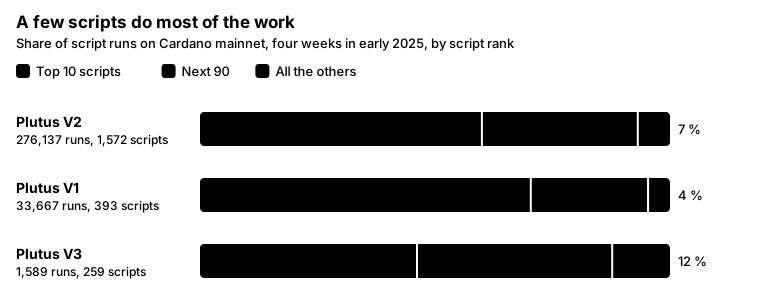
Share of script runs by script rank, per Plutus version. Data: CSV.
The usual power law, and exactly the shape a JIT wants: a few hot scripts, run over and over. On Cardano, scripts are immutable and addressed by their hash, so a compiled script is just a cache entry: compile once, key it by hash, and never invalidate it. The architecture is tiering, like the JVM itself: the interpreter answers immediately for cold scripts, and hot ones get compiled in the background and swapped in.
And here I owe Phil Wadler a correction. He told me that what I had built is not really a JIT: it compiles a whole script before running it. He is right. On its own, it is a staged compiler, and the real JIT in the picture is HotSpot – which is why this post calls the toy engine a staged compiler. But put it behind an interpreter, compile only the scripts that get hot, and the system is a JIT. The unit is the script instead of the method.
An honest caveat: Cardano nodes run the Haskell VM, so none of this speeds up layer-1 validation. The sweet spot is layer 2. Hydrozoa, a state-channel protocol written in Scala 3, runs its own ledger and applications, like an order-book exchange, and evaluates the same few scripts all day. That is where a JIT about three times faster than the reference VM matters.
Pick the tier your workload pays for
Not "always write a compiler". Pick the tier your workload pays for – the same idea as tiered compilation in HotSpot.
| Engine | fib 20 | Start-up | Use it for |
|---|---|---|---|
| Interpreter (CEK) | 1× | none | The spec and the test oracle. Cold and one-off scripts. |
| Closure compiler | 16× | milliseconds | Warm scripts. No metaprogramming needed. |
| Staged compiler | 35× | seconds + warm-up | The hot few: one script, many runs. |
The speed-ups are our toy engines on fib 20. On real contracts the gap is smaller, as the benchmark above shows.
Three lessons on the way:
- A staged compiler is an interpreter that returns code instead of values. If you can write an interpreter, you can write a type-safe compiler in Scala 3.
- Generate simple, monomorphic code and let the JVM do the clever optimizations.
- Create each
Exprwhere it will live.
None of this is specific to blockchains. Any interpreter with hot inputs – business rules, query filters, your own DSL – is a compiler waiting to happen.
Links
- Talk: ScalaDays 2026 session page
- Talk video: YouTube
- Slides: PDF
- Talk code: lantr-io/tiny-uplc-jit at
scala-days-2026– the mini-UPLC, the CEK machine, the closure compiler, the staged compiler, tests and JMH benchmarks - The production JIT:
scalus-uplc-jit-compilerin Scalus - Benchmark: plutus-vm-bench.lantr.io
- The staging fix upstream: scala/scala3#27335